Nancy Dougherty, an engineer at Proteus Biomedical, made her own set of "mindfulness pills" with embedded sensors that transmits signals to her phone, recording each time she took a different pill. By playing with technology and the placebo effect, she has found a way to manage her mood through mindfulness and quantified feedback via her phone. For example, she found that taking the "energy" pill actually made her bike harder, and a "focus" pill made her do more work. As a result, she found she didn't need to use the "calm" or "happy" pills. Watch this fascinating video for more details.

Showing posts with label depression. Show all posts
Showing posts with label depression. Show all posts

Nov 6, 2010
Fall

Sometimes the world outside my window is so golden and beautiful, it hurts the darkness in my soul to look because it is so starkly incongruous with my own internal weather.

drink in the crisp autumnal air
and fondle the fiery leaves before they are gone.

Then I remember that this symphony of blazing impermanence is a comfort. It reminds me that change is life's only constant and it is only in this moment that I am alive.
Photography by Shehani Kay.
May 7, 2010
DemonEyes

Negative thoughts are like demons who watch for every opportunity to stick a dagger in your heart. These demons have many spies and these many spies have many eyes with which to peek under your every rock, into your every crevice and closet.
This week I've been stalked by the demoneyes and I'm trying hard to shake off their penetrating stares and cackling laughter. Some time this week I sipped from the poisoned goblet and drank deep the rotten roots of my youth. Some wounds are so ancient and painful, they still sting and fester when scratched. This indiscretion allowed the darkness to billow like storm clouds in the prairie skies. So as this storm thunders around me and these demoneyes keep their vigil, I too will keep my own vigil and ride out this bad weather. I shall stay aware of my black self talk and remember well that feelings are as impermanent as clouds on a breezy day.
Happy Friday! I'm off to have some wine with friends, my antidote for mal humor.
Photography by Shehani Kay. Seen near Viaducto de Segovia in Madrid.
Feb 26, 2010
Adversity is just change we haven't adapted ourselves to yet
These past few weeks have been dark and uncertain ones. Things haven't been working out for me. The storm has been raging on relentlessly. No economic recovery in the forecast for Spain. My boat (teaching hours) has holes which I patch up only to have new leaks appear. The wolves have gathered by the shore. Sinking seems a real threat and I'm having trouble making ends meet. My mind has been racing around contingency plans and I've been plotting and rowing towards new growth. As I struggle to adapt to all this change, one of the inspirations I've been using to keep from drowning is a quote I wrote on a yellow post it note last week and stuck to the wall above my macbook.
It reads: "Adversity is just change we haven't adapted ourselves to yet."
Some weeks ago I watched a passionate talk by Aimee Mullins, a woman who was born without shin bones. Instead of allowing this early adversity to relegate her to the sidelines of life, she became a record-breaker at the Paralympic Games in 1996, and has built a career as a model, actor and activist for women, sports and the next generation of prosthetics. She compares her designer prosthetic legs to designer eyeglasses - she wore 4-inch stiletto heels during her TedMed talk!
Today I'd like to share her inspiring talk about finding opportunities in adversity.
Excerpts of Aimee's talk, transcribed by me:
"The human ability to adapt is our greatest asset...people continually ask me about overcoming adversity and I'm gonna make an admission, this phrase never sat right with me and I always felt uneasy trying to answer people's questions about it and I think I'm starting to figure out why. Implicit in this phrase of overcoming adversity is the idea that success or happiness is about emerging on the other side of a challenging experience unscathed or unmarked by the experience. As if my successes in life have come about from an ability to sidestep and circumnavigate the pitfalls of a life with prosthetics which people perceive as my disability. But in fact we are changed. We are marked, of course, by a challenge whether physically, emotionally or both and I'm gonna suggest that this is a good thing. Adversity isn't an obstacle we need to get around in order to resume living our life. It's part of our life and I tend to think of it like my shadow, sometimes I see a lot of it and sometimes there's very little but it's always with me. Certainly, I'm not trying to diminish the impact, the weight of a person's struggle. There is adversity and challenge in life and it's all very real and relative to every single person but the question isn't whether or not you're going to meet adversity but how you're going to meet it. Our responsibility is not simply to shield those we care for from adversity but preparing them to meet it well...
There is a partnership between those perceived deficiencies and our greatest creative ability. So it's not about devaluing or negating these more trying times as something we want to avoid or sweep under the rug but instead to find those opportunities wrapped in the adversity. So maybe the idea I want to put out there is not so much overcoming adversity as it is opening ourselves up to it, embracing it, grappling with it (to use a wrestling term), maybe even dancing with it. And perhaps if we see adversity as natural, consistent and useful, we're less burdened by the presence of it...
Conflict is the genesis of creation...the human ability to survive and flourish is driven by the struggle of the human spirit through conflict into transformation. So again transformation, adaptation is our greatest human skill. And perhaps until we're tested we don't know what we're made of. Maybe that's what adversity gives us, a sense of self, a sense of our own power. So we can give ourselves a gift, we can re-imagine adversity as something more than tough times. Maybe we can see it as change. Adversity is just change we haven't adapted ourselves to yet. I think the greatest adversity we've created for ourselves is this idea of normalcy. I mean who is normal? There is no normal. There's common, there's typical, but there's no normal and would you want to meet that poor beige person if they existed? I don't think so." Aimee Mullins
While I was slowly transcribing (due to my poor typing skills) these bits that resonated most for me, her words had time to sink in deep. I've decided to take her advice to heart and give myself a gift; the gift of a dance with adversity. As I write this, I'm tossing away my old metaphors of the leaky boat, wolves and bad weather; I'm instead imagining myself in a tight tango to the tune of Por una Cabeza.
Thanks Aimee for being an amazing woman of great spirit.
How will you re-imagine your adversity today?
Feb 2, 2010
Benefitting from Failure ~ Tuesday's Inspiration
A couple weeks ago I wrote about fearless failing and I supposed it was important to create without thought to the results or fear of failure. As a followup, I'd like to share a speech I saw yesterday in which JK Rowling talks about the benefits of failure:
From the transcript:
"So why do I talk about the benefits of failure? Simply because failure meant a stripping away of the inessential. I stopped pretending to myself that I was anything other than what I was, and began to direct all my energy into finishing the only work that mattered to me. Had I really succeeded at anything else, I might never have found the determination to succeed in the one arena I believed I truly belonged. I was set free, because my greatest fear had been realised, and I was still alive, and I still had a daughter whom I adored, and I had an old typewriter and a big idea. And so rock bottom became the solid foundation on which I rebuilt my life.
You might never fail on the scale I did, but some failure in life is inevitable. It is impossible to live without failing at something, unless you live so cautiously that you might as well not have lived at all – in which case, you fail by default.
Failure gave me an inner security that I had never attained by passing examinations. Failure taught me things about myself that I could have learned no other way. " J.K Rowling
Her moving speech about the fringe benefits of failure, the power of the imagination and the value of friendship made me laugh several times and weep even more.
What does it mean to fail? I suppose, it is something each of us needs to decide for ourselves. Someone's failure could be another's success and vice versa. Sometimes, when I'm down on my life, and I think about how I failed to get a proper career job after my expensive university education, and that this makes me a 'loser'. At other times, I'm thankful I succeeded in evading corporate slavery and that this uncertain path through the dense forest is exactly where I am supposed to be. Compared to many, I am free. I still get to do the things I love. I still get to follow my bliss. I don't work in an office 12 hours a day. I live abroad in Spain, munching on olives and sipping good red wine. I may not always have enough money to pay my bills on time, travel or buy clothes but I do have time to read, think, imagine, write, take photos, explore, watch films and research whatever topic happens to catch my fancy. In many ways, I am blessed because I have been such a 'failure'! Failure has always led me in alternative directions, some delightful, others not so much. Failure has also taught me that I can survive and thrive in spite of it all. So now, as I continue to wander down my precarious trail (my January blues hopefully now behind me), I will try to keep in mind that there is indeed beauty in uncertainty and benefits in failure.
It is my hope that you will remember this too.
"As is a tale, so is life: not how long it is, but how good it is, is what matters." Seneca
"We do not need magic to change the world, we carry all the power we need inside ourselves already: we have the power to imagine better." J.K Rowling
Oct 24, 2009
On days when the sun refuses to shine

I recently listened to an audiobook by Alain de Botton called How Proust can change your Life. This clever man has brilliantly distilled Proust for those of us not ready to wade though the 7 volumes and millions of words in In Search of Lost Time. Proust has a great many insights into human nature and how to live. Botton's audiobook has inspired me to one day delve into Proust first hand. For now, let me share with you a few quotes by Proust that I found helpful on days when the sun refuses to shine.
"Happiness is good for the body, but it is grief which develops the strengths of the mind."
"We cannot be taught wisdom, we have to discover it for ourselves by a journey which no one can undertake for us, an effort which no one can spare us."
"The moral: to recognize that our best chance at contentment is by taking up the wisdom offered to us in coded form through our coughs, allergies, social gaffes and emotional betrayals, and to avoid the ingratitude of those who blame the peas, the bores and the weather."
"The voyage of discovery is not in seeking new landscapes but in having new eyes."
"The voyage of discovery is not in seeking new landscapes but in having new eyes."
Oct 23, 2009
If you want something to believe in, believe in Life
I trust that life will unfold and I will be able to navigate its unfurling sequences.
I'm grateful for the people who walk their own paths and offer their flashlights to those of us who are learning to see in the dark.
I'm inspired by life's many amazing plot twists, cliff-hangers, reversals, pregnant pauses and poignant silences. It's the best show in town.

I'm grateful for the people who walk their own paths and offer their flashlights to those of us who are learning to see in the dark.
I'm inspired by life's many amazing plot twists, cliff-hangers, reversals, pregnant pauses and poignant silences. It's the best show in town.
Happy Friday!

Photography by me. Self-portrait taken on the swing carousal at the Parque de Atracciones in Madrid last winter.
Oct 10, 2009
My medicine bag
When I started this blog over a year ago, I wrote quite a bit about depression. I haven't written on the subject for a while and it's not because i don't have patches of darkness, I do, but I feel more confident that the depression is temporary and that it will lift. So what has happened to me in the last 14 months to change my equilibrium? Well, I've put together a medicine bag to combat the horribles.
The current contents of my depression medicine bag:
A change in perspective. I focussed on making a shift from self identifying as a depressed person to identifying as a person who has tendencies towards negative thinking, which left unchecked will lead to depression. Seems like a minor shift but it's not. Identifying yourself as a depressed person makes you a passive victim. Identifying as a person who has a tendency towards depression gives you back control and forces you to take responsibility for your mental health. Be as vigilant about monitoring your moods as a diabetic is about their blood sugar levels.
Meditate. I've been meditating daily for 2 1/2 years and I think it's helped me to find balance in my mind and in my life. I've done a series of different guided meditations, experimenting, looking for the right fit. My latest combination is an hour long brain entraining meditation by Holosync, augmented by breathing and affirmation practice and mindfulness practice. The brain entraining is supposed to help create neural connections between the right and left brain. I don't know if this is actually the case, but I find that I am more clear minded and calm since I began this particular program a month ago. Mindful meditation has also been really good for me and I recommend Jack Kornfield's The Inner Art Of Meditation audiobook.
Do Yoga. I recently bought a mat and try to follow a 40 minute video at least 2 - 3 times a week. I can feel the effects in my body and it feels good. It's helping me get back in touch with my body and altering my negative body image.
Eat more fruits and vegetables. Cut down on sugar and bread. No explanation necessary.
The current contents of my depression medicine bag:
A change in perspective. I focussed on making a shift from self identifying as a depressed person to identifying as a person who has tendencies towards negative thinking, which left unchecked will lead to depression. Seems like a minor shift but it's not. Identifying yourself as a depressed person makes you a passive victim. Identifying as a person who has a tendency towards depression gives you back control and forces you to take responsibility for your mental health. Be as vigilant about monitoring your moods as a diabetic is about their blood sugar levels.
Meditate. I've been meditating daily for 2 1/2 years and I think it's helped me to find balance in my mind and in my life. I've done a series of different guided meditations, experimenting, looking for the right fit. My latest combination is an hour long brain entraining meditation by Holosync, augmented by breathing and affirmation practice and mindfulness practice. The brain entraining is supposed to help create neural connections between the right and left brain. I don't know if this is actually the case, but I find that I am more clear minded and calm since I began this particular program a month ago. Mindful meditation has also been really good for me and I recommend Jack Kornfield's The Inner Art Of Meditation audiobook.
Do Yoga. I recently bought a mat and try to follow a 40 minute video at least 2 - 3 times a week. I can feel the effects in my body and it feels good. It's helping me get back in touch with my body and altering my negative body image.
Eat more fruits and vegetables. Cut down on sugar and bread. No explanation necessary.
Build a creative space. For me this space is here, my blog. It's my public notebook and it motivates me to keep producing work for an audience and for myself. As a creative person, having a forum where I can express myself and explore my passions is important to my sense of well-being.
Do NOT engage with angry freaks. They aren't interested in debate or intellectual sparring, they are trying to shadow box you in the head. They will often accuse you of doing the very things they themselves are doing to you and then try to force your emotional reaction by hitting below the belt. I repeat, DO NOT engage, don't feed them with your energy. Withdraw and focus instead on your friends, interests, movies, art, whatever brings you positive energy. Let the shadow boxers fight by themselves.
Get fascinated by things. Be curious. I've been watching TED a lot, following up on lectures that catch my fancy with more research. Science and the natural world is rich with amazing wonders. Lately I've been researching everything from string theory or the potential unified theory of everything to biomimicry to V.S. Ramachandran's investigations into phantom limb pain, synesthesia and other brain disorders, which have allowed him map the functions of the mind to the physical structures of the brain to how and where the brain thinks about other people's thoughts to Dan Dennett's ideas on consciousness to Richard Dawkin's call for militant atheism to positive psychology to neuroplasticity to understanding comics to the relationship between text and images to photography and photoshop techniques. The world is indeed stranger and more fascinating than we can possibly know. If you can't experience the splendor, the elegance and the jaw dropping wonder of the natural world then you are not awake.
In a TED lecture, Richard Dawkin's says this:
Do NOT engage with angry freaks. They aren't interested in debate or intellectual sparring, they are trying to shadow box you in the head. They will often accuse you of doing the very things they themselves are doing to you and then try to force your emotional reaction by hitting below the belt. I repeat, DO NOT engage, don't feed them with your energy. Withdraw and focus instead on your friends, interests, movies, art, whatever brings you positive energy. Let the shadow boxers fight by themselves.
Get fascinated by things. Be curious. I've been watching TED a lot, following up on lectures that catch my fancy with more research. Science and the natural world is rich with amazing wonders. Lately I've been researching everything from string theory or the potential unified theory of everything to biomimicry to V.S. Ramachandran's investigations into phantom limb pain, synesthesia and other brain disorders, which have allowed him map the functions of the mind to the physical structures of the brain to how and where the brain thinks about other people's thoughts to Dan Dennett's ideas on consciousness to Richard Dawkin's call for militant atheism to positive psychology to neuroplasticity to understanding comics to the relationship between text and images to photography and photoshop techniques. The world is indeed stranger and more fascinating than we can possibly know. If you can't experience the splendor, the elegance and the jaw dropping wonder of the natural world then you are not awake.
In a TED lecture, Richard Dawkin's says this:
Steve Grand points out that you and I are, ourselves, more like a wave than a permanent thing. He invites us, the reader, to "think of an experience from your childhood -- something you remember clearly, something you can see, feel, maybe even smell, as if you were really there. After all, you really were there at the time, weren't you? How else would you remember it? But here is the bombshell: You weren't there. Not a single atom that is in your body today was there when that event took place. Matter flows from place to place and momentarily comes together to be you. Whatever you are, therefore, you are not the stuff of which you are made. If that doesn't make the hair stand up on the back of your neck, read it again until it does, because it is important."
So these are some of the contents of my medicine bag. What do you have in yours?

So these are some of the contents of my medicine bag. What do you have in yours?

May 22, 2009
Going down the well and reemerging with a rebirth of wonder
In Sintra, Portugal there is a magical place called Quinta da Regaleira. Here you'll find a hidden entrance to an Initiation Well, which has a dark and mysterious passage leading to unknown places.
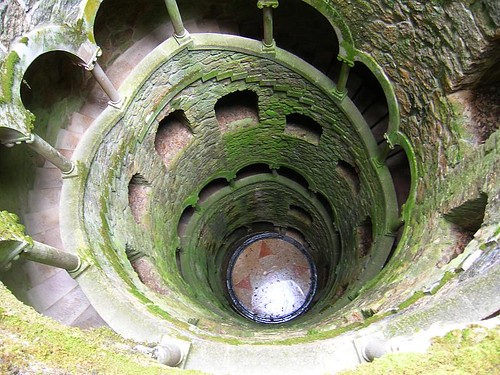
Descend half way down and you'll emerge at the Guardian's Entrance, which is nestled in dense foliage.

Descend deeper and you'll emerge at the waterfall and lake with stepping stones and carp swimming in its murky waters.

The last exit will take you to the Unfinished Well, a rustic stone rebirth canal that delivers you back into the world.

Descend half way down and you'll emerge at the Guardian's Entrance, which is nestled in dense foliage.
Descend deeper and you'll emerge at the waterfall and lake with stepping stones and carp swimming in its murky waters.
The last exit will take you to the Unfinished Well, a rustic stone rebirth canal that delivers you back into the world.
All these photos were taken by me in Sintra, Portugal during a journey that not only thrilled and delighted me, it more importantly reawakened in me a rebirth of wonder.
This well is a physical representation of a very old psychological process, a mythological journey into the underworld and the bringing back of hidden treasure. And what better treasure than a renewed sense of inspired wonder. It's brighter than all the gold and jewels in the world because it shines light into the dark corners of the soul. This experience is an essential part in the journey of the depressed mind and a reminder not to dwell in the darkness but instead to seek the light for during the journey to the surface, you will discover the very treasure you are seeking. At least this is how the journey has been for me. Have you had similar journeys? When was the last time you experienced a rebirth of wonder?
Happy Friday!
Feb 14, 2009
Blog post # 100
This is my 100th blog post at Mock Moons. This has been an interesting project for me. Mock Moons has given me a space to be creative and to channel my passions. It's helped me to discover other ways to express myself and made the daily grind of earning a living and riding metros less a focus in my everyday life. Blogging has become a part of my meaning making process and I am grateful to everyone who has stopped by and taken an interest in my stuff. Your hands lift up the window shutters and let in a sliver of moonlight into my dark spaces. Thanks.
Sep 25, 2008
in praise of melancholy
Not everyone wants to be happy. Eric G. Wilson, for example, writes in praise of melancholy. He is afraid that American culture's overemphasis on happiness at the expense of sadness might be dangerous, a wanton forgetting of an essential part of a full life. "The American dream of happiness might be a nightmare," he writes, "What passes for bliss could well be a dystopia of flaccid grins."
If you avoid life's profound lows, how do you appreciate life's profound highs? Isn't life about riding this tension of opposites? As a counterpoint to my many posts on ways to cope with depression and cultivate happiness and joy, I want to present a writer who ventures bravely into the darkness and brings us back another view of life.
excerpts from In Praise of Melancholy:
There is a fine line between what I'm calling melancholia and what society calls depression. In my mind, what separates the two is degree of activity. Both forms are more or less chronic sadness that leads to continuing unease with how things are — persistent feelings that the world is not quite right, that it is a place of suffering, stupidity, and evil. Depression (as I see it, at least) causes apathy in the face of this unease, lethargy approaching total paralysis, an inability to feel much of anything one way or another. In contrast, melancholia generates a deep feeling in regard to this same anxiety, a turbulence of heart that results in an active questioning of the status quo, a perpetual longing to create new ways of being and seeing.
Melancholia, far from a mere disease or weakness of will, is an almost miraculous invitation to transcend the banal status quo and imagine the untapped possibilities for existence. Without melancholia, the earth would likely freeze over into a fixed state, as predictable as metal. Only with the help of constant sorrow can this dying world be changed, enlivened, pushed to the new.
Melancholia pushes against the easy "either/or" of the status quo. It thrives in unexplored middle ground between oppositions, in the "both/and." It fosters fresh insights into relationships between oppositions, especially that great polarity life and death. It encourages new ways of conceiving and naming the mysterious connections between antinomies. It returns us to innocence, to the ability to play in the potential without being constrained to the actual. Such respites from causality refresh our relationship to the world, grant us beautiful vistas, energize our hearts and our minds.
Suffering the gloom, inevitable as breath, we must further accept this fact that the world hates: We are forever incomplete, fragments of some ungraspable whole. Our unfinished natures — we are never pure actualities but always vague potentials — make life a constant struggle, a bout with the persistent unknown. But this extension into the abyss is also our salvation. To be only a fragment is always to strive for something beyond ourselves, something transcendent. That striving is always an act of freedom, of choosing one road instead of another. Though this labor is arduous — it requires constant attention to our mysterious and shifting interiors — it is also ecstatic, an almost infinite sounding of the exquisite riddles of Being.
To be against happiness is to embrace ecstasy. Incompleteness is a call to life. Fragmentation is freedom. The exhilaration of never knowing anything fully is that you can perpetually imagine sublimities beyond reason. On the margins of the known is the agile edge of existence. This is the rapture, burning slow, of finishing a book that can never be completed, a flawed and conflicted text, vexed as twilight.
If you avoid life's profound lows, how do you appreciate life's profound highs? Isn't life about riding this tension of opposites? As a counterpoint to my many posts on ways to cope with depression and cultivate happiness and joy, I want to present a writer who ventures bravely into the darkness and brings us back another view of life.
excerpts from In Praise of Melancholy:
There is a fine line between what I'm calling melancholia and what society calls depression. In my mind, what separates the two is degree of activity. Both forms are more or less chronic sadness that leads to continuing unease with how things are — persistent feelings that the world is not quite right, that it is a place of suffering, stupidity, and evil. Depression (as I see it, at least) causes apathy in the face of this unease, lethargy approaching total paralysis, an inability to feel much of anything one way or another. In contrast, melancholia generates a deep feeling in regard to this same anxiety, a turbulence of heart that results in an active questioning of the status quo, a perpetual longing to create new ways of being and seeing.
Melancholia, far from a mere disease or weakness of will, is an almost miraculous invitation to transcend the banal status quo and imagine the untapped possibilities for existence. Without melancholia, the earth would likely freeze over into a fixed state, as predictable as metal. Only with the help of constant sorrow can this dying world be changed, enlivened, pushed to the new.
Melancholia pushes against the easy "either/or" of the status quo. It thrives in unexplored middle ground between oppositions, in the "both/and." It fosters fresh insights into relationships between oppositions, especially that great polarity life and death. It encourages new ways of conceiving and naming the mysterious connections between antinomies. It returns us to innocence, to the ability to play in the potential without being constrained to the actual. Such respites from causality refresh our relationship to the world, grant us beautiful vistas, energize our hearts and our minds.
Suffering the gloom, inevitable as breath, we must further accept this fact that the world hates: We are forever incomplete, fragments of some ungraspable whole. Our unfinished natures — we are never pure actualities but always vague potentials — make life a constant struggle, a bout with the persistent unknown. But this extension into the abyss is also our salvation. To be only a fragment is always to strive for something beyond ourselves, something transcendent. That striving is always an act of freedom, of choosing one road instead of another. Though this labor is arduous — it requires constant attention to our mysterious and shifting interiors — it is also ecstatic, an almost infinite sounding of the exquisite riddles of Being.
To be against happiness is to embrace ecstasy. Incompleteness is a call to life. Fragmentation is freedom. The exhilaration of never knowing anything fully is that you can perpetually imagine sublimities beyond reason. On the margins of the known is the agile edge of existence. This is the rapture, burning slow, of finishing a book that can never be completed, a flawed and conflicted text, vexed as twilight.
Sep 24, 2008
Keeping the horribles at bay: an interview with Honeybottom pt 4
Today's post is the final installment in a 4 part series on depression, Keeping the horribles at bay: an interview with Honeybottom.
In Keeping the horribles at bay: an interview with Honeybottom pt 1, Professor Honeybottom, a Chartered Herbalist and a former Registered Nurse, explained the difference between depression and sadness. In part 2, she talked about how changes in diet, exercise and sleeping habits can help to relieve depression. In part 3, she recommended lifestyle changes and self help strategies.
In today's post, Honeybottom tells us how she beats the blues in her own daily life.
Nature is my true tonic. I remember the first time I realized this was when I was going through a small personal hell and felt so incredibly sad that I almost couldn't move. I forced myself to go and lie down outside, where I just laid there quietly sobbing into my blanket. I realized an ant was on my arm...the next thing I knew was that 1or 2 minutes had actually passed and I hadn't been consumed with my grief. 1or 2 minutes! That was huge; that little ant placed me in the now...there was no room for my overwhelming sadness. Nature had used up the room.
I gladly walk, bike or lie outside everyday. If I feel myself just stumbling through a day I'll pick one thing that I must pay attention to... noses, ears, hands; everyone that I come in contact with I'll note. These silly little exercises keep me focused in the moment and usually come with a little pearl of wisdom at the end of the day or at least a funny experience to recount.
I surround myself with people I love and realize that I am not responsible for their experiences. This has taken me my lifetime to bring into my reality. I try everyday to be radiating something that is good for the planet; regenerative and bright. Everyday can't be a winner.
I divide up my daily processes into three parts, everything, every process/experience on the planet can be divided into these three groups;
Custodial: That which promotes and uplifts life. Pertaining to higher than planetary forces.
Maintenance: That which maintains proper functioning of the body and the planet.
Expendable: That which is not of use to the human or planet.
It is understandable that our daily mental processes would be divided up amongst these three frequencies. When I go to bed at night, before I close my eyes, I try to find and identify those top processes that I had during the day. Sometimes it's difficult and seemingly takes forever. But it's worth it: even the smallest moment shouldn't be overlooked. A fantastic day is when I can keep at least two-thirds of my day in Custodial and Maintenance. It is not easy. Everyday is a struggle. But also a new chance at it.
In Keeping the horribles at bay: an interview with Honeybottom pt 1, Professor Honeybottom, a Chartered Herbalist and a former Registered Nurse, explained the difference between depression and sadness. In part 2, she talked about how changes in diet, exercise and sleeping habits can help to relieve depression. In part 3, she recommended lifestyle changes and self help strategies.
In today's post, Honeybottom tells us how she beats the blues in her own daily life.
Nature is my true tonic. I remember the first time I realized this was when I was going through a small personal hell and felt so incredibly sad that I almost couldn't move. I forced myself to go and lie down outside, where I just laid there quietly sobbing into my blanket. I realized an ant was on my arm...the next thing I knew was that 1or 2 minutes had actually passed and I hadn't been consumed with my grief. 1or 2 minutes! That was huge; that little ant placed me in the now...there was no room for my overwhelming sadness. Nature had used up the room.
I gladly walk, bike or lie outside everyday. If I feel myself just stumbling through a day I'll pick one thing that I must pay attention to... noses, ears, hands; everyone that I come in contact with I'll note. These silly little exercises keep me focused in the moment and usually come with a little pearl of wisdom at the end of the day or at least a funny experience to recount.
I surround myself with people I love and realize that I am not responsible for their experiences. This has taken me my lifetime to bring into my reality. I try everyday to be radiating something that is good for the planet; regenerative and bright. Everyday can't be a winner.
I divide up my daily processes into three parts, everything, every process/experience on the planet can be divided into these three groups;
Custodial: That which promotes and uplifts life. Pertaining to higher than planetary forces.
Maintenance: That which maintains proper functioning of the body and the planet.
Expendable: That which is not of use to the human or planet.
It is understandable that our daily mental processes would be divided up amongst these three frequencies. When I go to bed at night, before I close my eyes, I try to find and identify those top processes that I had during the day. Sometimes it's difficult and seemingly takes forever. But it's worth it: even the smallest moment shouldn't be overlooked. A fantastic day is when I can keep at least two-thirds of my day in Custodial and Maintenance. It is not easy. Everyday is a struggle. But also a new chance at it.
***
I'd like to thank Professor Honeybottom for taking the time and energy to give us advice on how to cope with depression. I found her ideas both interesting and refreshing. I hope you did too. If you'd like to read more of her work, she has a graphic novel series on health and the body, called the Naked Truth.
Sep 20, 2008
Keeping the horribles at bay: an interview with Honeybottom pt 3
Today's post is part 3 of 4 in the series on depression, Keeping the horribles at bay: an interview with Honeybottom.
Are there any lifestyle changes or self-help strategies that you recommend? ie: meditation, yoga, behaviour modification, strategies for breaking the pattern of negative thinking, etc.
I honestly believe that yoga should be part of everyone's life. There is a level of practise, style, pace for absolutely everyone. It strengthens, lengthens, and even massages the internal organs! The teachings and lifestyle that go with a full on yogic journey are all positive and up lifting. It makes my heart glad that there is those that powerfully emanate that into the world.
What you say, what you hear yourself say and what you hear others say about you has a profound effect on you. Science has recently proven that the speech centre in the brain rules all of the nerves of the body. Simply speaking positive or negative words gives you the power to manipulate the physical complex. Meaning; if you say 'I am old, I'm sick, I'm useless' this sets the mandate for your body to start to decompose. We live in a crazy world, where the amazing gift of free will has run amok and sometimes it is hard to see the positive or feel the positive. I make a note to never watch the news: that is just a big ball of negative. When I had a desk at a workplace I got my friends, partner, and work peers to write down five things they enjoyed or appreciated about me (I did this on days when the two of us would have a good connection) and I would keep them posted where I saw them everyday. I also carry pictures that calm me and uplift me. I use these links most of the time to bring my electrics or brain waves up the bar to a regenerative state.
Call–overs and mantras are powerful only when they are truly believed. So I suggest using wording you can believe in, ie: 'I am in stillness and calm' might not be true at the moment but, 'I am moving towards stillness and calm' might have more influence. I think the best two for those suffering from depression are: 'I am loved' and 'I am worthy of love and happiness'.
Of course! Yes you are and all patterns that are within the negative must be broken for you to stop falling out of love with yourself. If you find that when you become depressed you tend to stay in and try to sleep away days, force yourself to do the opposite. Go for a walk, go lie in the grass; if you must just sleep, sleep on the porch or at a friend’s. Try to break the patterning. If you find you fall deep and don't remember or care to help yourself, leave yourself reminders that you can't overlook; upside down living room chair, cutlery in the bathroom etc.
One thing I have encountered in my work is that some people feel guilty or ashamed at having to take medication for their depression. A word to those people: This is just a weakened system, like some people have a weakened digestive system, reproductive system, or any other system of the body; it is not you, it's just the equipment. I believe anti-depressants are necessary to quickly restore a feeling of balance to the mind. In the long term I would suggest working with your doctor or holistic practitioner, in helping you find an equally good outcome using more body friendly medicines.
Much research has gone into supplements like 5HTP (5- hydroxytryptophan), DHA and EPA from fish oils and high doses of Vitamin D. I personally know more than a few people who have been helped with these items. 5HTP cannot be taken with most anti-depressants and fish oils do have mild blood thinning capacities. High doses of any vitamin can cause imbalance elsewhere, so work closely with your health care professional when changing or adding any medications or supplements.
see also:
Keeping the horribles at bay: an interview with Honeybottom pt 1
Keeping the horribles at bay: an interview with Honeybottom pt 2
Are there any lifestyle changes or self-help strategies that you recommend? ie: meditation, yoga, behaviour modification, strategies for breaking the pattern of negative thinking, etc.
I honestly believe that yoga should be part of everyone's life. There is a level of practise, style, pace for absolutely everyone. It strengthens, lengthens, and even massages the internal organs! The teachings and lifestyle that go with a full on yogic journey are all positive and up lifting. It makes my heart glad that there is those that powerfully emanate that into the world.
What you say, what you hear yourself say and what you hear others say about you has a profound effect on you. Science has recently proven that the speech centre in the brain rules all of the nerves of the body. Simply speaking positive or negative words gives you the power to manipulate the physical complex. Meaning; if you say 'I am old, I'm sick, I'm useless' this sets the mandate for your body to start to decompose. We live in a crazy world, where the amazing gift of free will has run amok and sometimes it is hard to see the positive or feel the positive. I make a note to never watch the news: that is just a big ball of negative. When I had a desk at a workplace I got my friends, partner, and work peers to write down five things they enjoyed or appreciated about me (I did this on days when the two of us would have a good connection) and I would keep them posted where I saw them everyday. I also carry pictures that calm me and uplift me. I use these links most of the time to bring my electrics or brain waves up the bar to a regenerative state.
Call–overs and mantras are powerful only when they are truly believed. So I suggest using wording you can believe in, ie: 'I am in stillness and calm' might not be true at the moment but, 'I am moving towards stillness and calm' might have more influence. I think the best two for those suffering from depression are: 'I am loved' and 'I am worthy of love and happiness'.
Of course! Yes you are and all patterns that are within the negative must be broken for you to stop falling out of love with yourself. If you find that when you become depressed you tend to stay in and try to sleep away days, force yourself to do the opposite. Go for a walk, go lie in the grass; if you must just sleep, sleep on the porch or at a friend’s. Try to break the patterning. If you find you fall deep and don't remember or care to help yourself, leave yourself reminders that you can't overlook; upside down living room chair, cutlery in the bathroom etc.
One thing I have encountered in my work is that some people feel guilty or ashamed at having to take medication for their depression. A word to those people: This is just a weakened system, like some people have a weakened digestive system, reproductive system, or any other system of the body; it is not you, it's just the equipment. I believe anti-depressants are necessary to quickly restore a feeling of balance to the mind. In the long term I would suggest working with your doctor or holistic practitioner, in helping you find an equally good outcome using more body friendly medicines.
Much research has gone into supplements like 5HTP (5- hydroxytryptophan), DHA and EPA from fish oils and high doses of Vitamin D. I personally know more than a few people who have been helped with these items. 5HTP cannot be taken with most anti-depressants and fish oils do have mild blood thinning capacities. High doses of any vitamin can cause imbalance elsewhere, so work closely with your health care professional when changing or adding any medications or supplements.
***
In the part 4, Professor Honeybottom will talk about she beats the blues in her own daily life. So stay tuned.see also:
Keeping the horribles at bay: an interview with Honeybottom pt 1
Keeping the horribles at bay: an interview with Honeybottom pt 2
Sep 16, 2008
Keeping the horribles at bay: an interview with Honeybottom pt 2
Today's post is part 2 of 4 in the series on depression, Keeping the horribles at bay: an interview with Honeybottom.
How can changes in diet, exercise and sleeping habits help to relieve depression?
Well, we've touched briefly on toxins in food as being able to induce states of depression. Toxins are used on our food as fertilizer, insecticide, ripening agents, ant-ripening agents, preservatives, and in processing. Eat as much organic as you can get your hands on, or afford, or grow. Stay away from genetically altered food: it's molecular matrices do not fit with our own and will not promote life. Over eating will cause the bowel to back up, toxins flowing freely back into the bloodstream. Fasting will cause the body to move into healing mode, if the body is strong enough it will try to unload toxins from the tissues into the bloodstream for removal from the body. A cleansing body can put one into a state of depression while it deals with scarring thought patterns, and mental blockages which have manifested into physical disease processes. Healing begins from the head down from the inside to the outside from the highest priority area (most life threatening) then onto the next highest priority. So, if you're going to be cleansing or improving your diet make sure you have back up support (someone checking in with you)...as the toxins leave your system it may be rough.
Exercise is essential for us as organisms; oxygenation of all tissues is a must. Oxygen to the brain increases alertness and helps us to engage more fully in the moment. Our biological and physical make-up make movement essential to life. Lymph flow is not dependant upon a pump, like the circulatory system, but it depends on us physically moving; that's why trampolines and re-bounders are health inducing. Lymph nodes contain large number of lymphocytes. Lymphocytes act against foreign particles, such as bacterial cells and viruses, carrying them back to the node and there special cells engulf and destroy all foreign substances, damaged cells and cellular debris.
Sleep is usually something we are all short of. We know that the Earth's low frequency iso-electric field, the Earth's magnetic field and our own electrical emanations are all closely interwoven. They affect and interact with each other and any subtle change can be detected by all. We might not know what we are registering, but perhaps that just takes practise. Earthquakes and electrical storms are registered by the planet as global. They are registered by you too, even if you are never aware of it. Disturbances on the planet can affect us negatively or positively. It is interesting to note that when there is earthquake activity there is an increase in anxiety in the population, an increase in UFO sightings and feelings of being watched are prevalent amongst study groups. Earthquakes release a large amount of energy into the planets atmosphere and, after all, we are electrical creatures. Basically, what sleep is, is a series of alternating currents which help dislodge stagnant energies and recharge or absorb energy. Low frequencies, which are produced from light sleep or meditation right up to deepest dreamless sleep or the deepest meditation, are essential to our health. These frequencies can cause environmental synchronization and trigger the release of a growth hormone which is important for healing and regeneration and allow feelings of profound peace.
see also:
Keeping the horribles at bay: an interview with Honeybottom pt 1
How can changes in diet, exercise and sleeping habits help to relieve depression?
Well, we've touched briefly on toxins in food as being able to induce states of depression. Toxins are used on our food as fertilizer, insecticide, ripening agents, ant-ripening agents, preservatives, and in processing. Eat as much organic as you can get your hands on, or afford, or grow. Stay away from genetically altered food: it's molecular matrices do not fit with our own and will not promote life. Over eating will cause the bowel to back up, toxins flowing freely back into the bloodstream. Fasting will cause the body to move into healing mode, if the body is strong enough it will try to unload toxins from the tissues into the bloodstream for removal from the body. A cleansing body can put one into a state of depression while it deals with scarring thought patterns, and mental blockages which have manifested into physical disease processes. Healing begins from the head down from the inside to the outside from the highest priority area (most life threatening) then onto the next highest priority. So, if you're going to be cleansing or improving your diet make sure you have back up support (someone checking in with you)...as the toxins leave your system it may be rough.
Exercise is essential for us as organisms; oxygenation of all tissues is a must. Oxygen to the brain increases alertness and helps us to engage more fully in the moment. Our biological and physical make-up make movement essential to life. Lymph flow is not dependant upon a pump, like the circulatory system, but it depends on us physically moving; that's why trampolines and re-bounders are health inducing. Lymph nodes contain large number of lymphocytes. Lymphocytes act against foreign particles, such as bacterial cells and viruses, carrying them back to the node and there special cells engulf and destroy all foreign substances, damaged cells and cellular debris.
Sleep is usually something we are all short of. We know that the Earth's low frequency iso-electric field, the Earth's magnetic field and our own electrical emanations are all closely interwoven. They affect and interact with each other and any subtle change can be detected by all. We might not know what we are registering, but perhaps that just takes practise. Earthquakes and electrical storms are registered by the planet as global. They are registered by you too, even if you are never aware of it. Disturbances on the planet can affect us negatively or positively. It is interesting to note that when there is earthquake activity there is an increase in anxiety in the population, an increase in UFO sightings and feelings of being watched are prevalent amongst study groups. Earthquakes release a large amount of energy into the planets atmosphere and, after all, we are electrical creatures. Basically, what sleep is, is a series of alternating currents which help dislodge stagnant energies and recharge or absorb energy. Low frequencies, which are produced from light sleep or meditation right up to deepest dreamless sleep or the deepest meditation, are essential to our health. These frequencies can cause environmental synchronization and trigger the release of a growth hormone which is important for healing and regeneration and allow feelings of profound peace.
***
In the part 3, Professor Honeybottom will talk about lifestyle changes and self help strategies in coping with depression. So stay tuned.see also:
Keeping the horribles at bay: an interview with Honeybottom pt 1
Sep 13, 2008
Keeping the horribles at bay: an interview with Honeybottom pt 1
When I first met the lady behind Professor Honeybottom, I was struck by her light. Her positive energy, good health, beauty and sexiness radiated an aura of love, acceptance and friendliness. She has recently begun posting a graphic novel series on health and the body, called the Naked Truth. Her observations, and presentation of the facts on anatomy and health are informative, entertaining and the sexiest I've ever seen. In fact, I think she might be the sexiest herbalist/nurse on the web! But what I am most impressed with are her wisdom and intellect. So I had a bright idea. Why not pick her brain on remedies and strategies for coping with depression. She agreed to do the interview and answered my questions via email.
Today's post is part 1 of 4 in the series, Keeping the horribles at bay: an interview with Honeybottom.
First of all, can you tell us a little about yourself.
I've been in the health care industry for over 20 years. I am a Chartered Herbalist and a former Registered Nurse. I have a fluid belief system and have been known to change my mind because of new scientific research, or a profound personal experience.
Growth is essential in all aspects, the only other option on this planet is death; we are moving toward one of them at all times.
I believe we should have the right to govern our own bodies and take responsibility for our health and healing. I also support the right to govern our own gardens: food is our medicine and medicine our food.
Oh, and I love furry animals and all flowers, even stinky ones.
Some people confuse depression with sadness, how do you think depression is different from sadness?
Sadness is an emotional response to an event, action or inaction. Depression is a state. A state that can be induced by:
Today's post is part 1 of 4 in the series, Keeping the horribles at bay: an interview with Honeybottom.
First of all, can you tell us a little about yourself.
I've been in the health care industry for over 20 years. I am a Chartered Herbalist and a former Registered Nurse. I have a fluid belief system and have been known to change my mind because of new scientific research, or a profound personal experience.
Growth is essential in all aspects, the only other option on this planet is death; we are moving toward one of them at all times.
I believe we should have the right to govern our own bodies and take responsibility for our health and healing. I also support the right to govern our own gardens: food is our medicine and medicine our food.
Oh, and I love furry animals and all flowers, even stinky ones.
Some people confuse depression with sadness, how do you think depression is different from sadness?
Sadness is an emotional response to an event, action or inaction. Depression is a state. A state that can be induced by:
- Toxins in the system from food, environment, medication, dental fillings, vaccines.
- An increase or decrease in hormone secretions.
- Altered blood and tissue PH , which can be caused by an overly acidic diet, environmental factors and negative brain patterning.
***
In the part 2, Professor Honeybottom will talk about how changes in diet, exercise and sleeping habits can help to relieve depression. So stay tuned.
Sep 9, 2008
meditation slideshow
This slideshow is courtesy of Ten Second Meditation.
I've been practicing those "incantations" I mentioned in work blues using this slideshow. The statements are timed for breathing in 5 seconds then breathing out for 5 seconds when the words slide offscreen. Say half the sentence while breathing in and the other half while breathing out. For example, with this first incantation, I say, "I am completely.." breathing in.. "stopping.." breathing out. Hopefully this makes sense. I like this meditation a lot. It's a quick way to get centered. All 12 incantations take only 2 minutes. The slideshow is an aid to remembering the incantations and I personally like the beautiful painted vistas to look at. I've been quite down lately so every little thing I can do to keep calm and centered on the present moment really helps.. Try it out and let me know what you think.
This slideshow has inspired me to create my own using my photos and flute music but I'll need to learn some new software skills to pull it off. Once I've got it figured out, I'll post my own version.
peace out
Sep 3, 2008
Face of fear

"Our faces of fear". Taken in Granada. I feel a little like this face at the moment so I decided to be dramatic and post this photo.
Sep 2, 2008
work blues
It's September and I need to start making some money. The TEFL market in Madrid is waking up from its summer slumber and I need to be the early bird pecking the ground for worms. It's a cowboy business with little job security or loyalty at the best of times but with the Spanish belt tightening, I'm not sure if this is still a teacher's market. I've got half my schedule filled but the blocks of hours aren't my ideal. Oh well. Can't get too picky at this early stage. This is the third school year I've weathered here in Madrid and you'd think I'd be a seasoned pro with no worries and some sort of job security by now. Nope, it's still a stressful chaos of uncertainty. It's a freelance dice game with no guarantees. For example, the large block of 18 hours per week I had last year has been reduced to a paltry 6 hours. Companies can change their minds last minute so no one can bank on anything. Currently, I've accepted classes from two academies and I'm still in negotiation with one other. And I'm getting some response from the mass blast of my CV I sent out a month ago but they seem to want to pay below average wages so screw 'em. I'm not that desperate yet. Fingers crossed. Hopefully it'll all work out. Chin up and all that. I just wish I didn't get the onset of depression and despair when uncertainty looms large. It's not very helpful.
So no surprise, I awoke with a knotted heavy heart this morning. To dissolve this heaviness I've been looking for more meditation techniques to get tranquila. Today I went back to Eric Maisel's podcasts and tried out his Ten Zen Seconds method, which combines Eastern mindfulness practices and Western cognitive psychology. By combining deep breathing and positive phrases (he calls them incantations) you can get centered. For example, you breathe in for 5 seconds and breathe out for 5 while saying, "I expect nothing" or "I make my meaning." The trick is to say half the sentence breathing in and the other half breathing out and to do it every day. Break old habits with new habits. So this is the latest addition to my 1 hour meditation regiment. I'll let you know how it works out.
If any of you have leads on other types of meditation practices, things you do to stay calm, I'd love to hear from you.
So no surprise, I awoke with a knotted heavy heart this morning. To dissolve this heaviness I've been looking for more meditation techniques to get tranquila. Today I went back to Eric Maisel's podcasts and tried out his Ten Zen Seconds method, which combines Eastern mindfulness practices and Western cognitive psychology. By combining deep breathing and positive phrases (he calls them incantations) you can get centered. For example, you breathe in for 5 seconds and breathe out for 5 while saying, "I expect nothing" or "I make my meaning." The trick is to say half the sentence breathing in and the other half breathing out and to do it every day. Break old habits with new habits. So this is the latest addition to my 1 hour meditation regiment. I'll let you know how it works out.
If any of you have leads on other types of meditation practices, things you do to stay calm, I'd love to hear from you.
Aug 13, 2008
Cinematherapy: bringing down your psychic-emotional walls
I've been watching a lot of movies and tv series since going high-speed. The Sopranos, Six Feet Under, BBC Planet Earth, Kenneth Clark's Civilization, the list goes on and on. I've rationalized my copious movie and tv consumption as nutritious couch potato time because I choose only the acclaimed stuff. No junk. Just the cream. OK, maybe a little Survivor but it's sociologically and psychologically interesting. We always have discussions following each episode. And as it turns out, this can be therapeutic.
Cinematherapy is a therapeutic intervention that is growing in popularity. In Psychology Today, Stuart Fischoff, Ph.D blogs about this subject in part one of Movies and Psychotherapy = Cinematherapy. He says:
Cinematherapy is a therapeutic intervention that is growing in popularity. In Psychology Today, Stuart Fischoff, Ph.D blogs about this subject in part one of Movies and Psychotherapy = Cinematherapy. He says:
Movies constitute the premier popular culture form of the day in no small way because of the psychophysiological properties of the film medium; moreover, it does not require the ability to read-not an insignificant advantage. While film has been justly called an "emotion machine," it is also a multi-sensory medium. More than any other medium of entertainment and communication, movies richly represent the swirl of messages: flesh, mind, ideas, pain, pride and laughter, the symbols and images that define what we call "the human condition."Yes, good movies can be a cathartic experience, they arouse our feelings and give us emotional release.
"The value of movies to progress in therapy is in their capacity to deal with issues that patients can't or won't discuss because they are too painful or too frightening. Movies can bring down psychic-emotional barriers, penetrate the wall of resistance, both conscious and unconscious, oftentimes very deftly and then open up the issues aroused for discussion in therapy....Often, is easier for patients to discuss problems when they are talking about a character in a movie."How true. Sometimes it's easier to talk in 3rd person, to project. So next time you watch a show, talk about it. It may be good for your mental health.
Aug 11, 2008
Keeping the Horribles at Bay: Life as Stories
In his 2003 Massey lecture, award-winning author and scholar Thomas King talked about storytelling - how stories shape who we are and how we understand and interact with other people. He talked about the wondrous and dangerous aspects of stories and the moral and social responsibility carried by the storytellers. It was a fascinating lecture series before podcasting so I had to actually set time aside to sit beside a radio. How old skool! Anyway, The Truth about Stories: A Native Narrative, got me very interested in the idea that we are both a collection of stories we tell ourselves and others and the stories others tell about us (our socially constructed identity).
Because I've moved from city to city with regularity, I've had to tell my stories over and over to different people. Every place I've lived has allowed me to amplify some experiences and downplay (or omit) other experiences. I can choose the stories I share. Because I have a blank slate while travelling, I create my identity and meaning by my choice of stories. The only person packing my baggage is me. However, like undies and socks, my depression narratives always get packed.
In past weeks I've written about mindful meditations in controlling depression and making meaning by using the metaphor of life as story. This week, I'm going to look at how narrative therapy seeks to make meaning from our stories so that we can heal. What exactly is narrative therapy? Therapist, Erik Sween, has an article that explains narrative concepts in layman terms:
Because I've moved from city to city with regularity, I've had to tell my stories over and over to different people. Every place I've lived has allowed me to amplify some experiences and downplay (or omit) other experiences. I can choose the stories I share. Because I have a blank slate while travelling, I create my identity and meaning by my choice of stories. The only person packing my baggage is me. However, like undies and socks, my depression narratives always get packed.
In past weeks I've written about mindful meditations in controlling depression and making meaning by using the metaphor of life as story. This week, I'm going to look at how narrative therapy seeks to make meaning from our stories so that we can heal. What exactly is narrative therapy? Therapist, Erik Sween, has an article that explains narrative concepts in layman terms:
- Every type of psychotherapy designates a different aspect of life as the basic unit of experience. For example, behavioral therapy focuses on behavior, cognitive therapy focuses on logical thinking, while systems therapy focuses on family interaction as the basic unit. In this way, narrative therapy holds up the story as the basic unit of experience. Stories guide how people act, think, feel, and make sense of new experience. Stories organize the information from a person's life. Narrative therapy focuses on how these important stories can get written and re-written.
- Narrative therapy proposes that people use certain stories about themselves like the lens on a camera. These stories have the effect of filtering a person's experience and thereby selecting what information gets focused in or focused out. These stories shape people's perspectives of their lives, histories, and futures. Despite information to the contrary, these stories of identity can be remarkably stable. Narrative therapy provides a means to refocus the lens on this camera and help reshape a person's stories and life.
- As people, we are inescapably meaning-makers. We have an experience and then attach meaning to it. Since time immemorial, and the days around the campfire, we have been telling stories. Stories are our most familiar means of communicating the meaning we find in our experiences. Narrative therapy is interested in the stories we live by - those stories we carry with us about who we are and what is most important to us. Narrative therapy involves unearthing these stories, understanding them, and re-telling them.
- Many forms of psychology and therapy place enormous emphasis on the process of individuation. In this way, the individual is believed to construct her or his internal world almost single-handedly. Narrative therapy provides a contrast to this perspective. Narrative therapy proposes that identity is co-created in relationship with other people as well as by one's history and culture. Thus, being seen by others in a certain way can contribute as much as seeing oneself in a certain way. We come to see ourselves by looking in the mirrors that other people hold up for us. In this way, a person's identity is said to be socially constructed. Narrative therapy focuses on the degree to which that socially constructed identity fits for that person.
- Narrative therapy consists of understanding the stories or themes that have shaped a person's life. Out of all the experiences a person has lived, what has held the most meaning? What choices, intentions, relationships have been most important? Narrative therapy proposes that only those experiences that are part of a larger story will have significant impact on a person's lived experience. Therefore, narrative therapy focuses on building the plot which connects a person's life together.
- A person's life is criss-crossed by invisible story-lines. These unseen story-lines can have enormous power in shaping a person's life. Narrative therapy involves the process of drawing out and amplifying these story-lines. Questions are used to focus on what has been most meaningful in a person's life. Common areas of inquiry include intentions, influential relationships, turning-points, treasured memories, and how these areas connect with each other.
Subscribe to:
Posts (Atom)
